

ESG Governance Structure
ESG Governance Structure
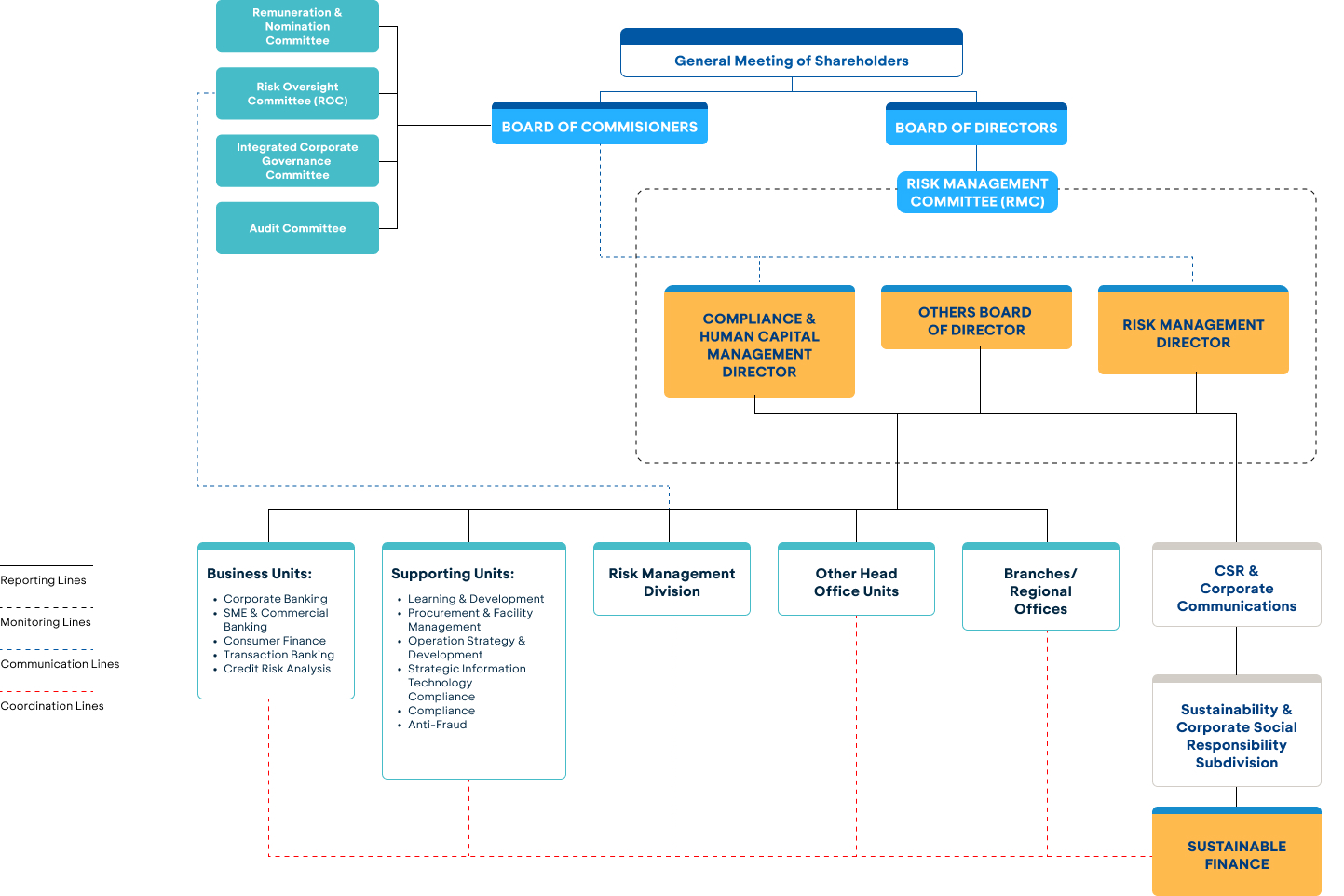
Risk Oversight Committee (ROC)
The Risk Oversight Committee (ROC) is a Board-level committee established by and reporting to the Board of Commissioners, which serves as BCA’s supervisory board under Indonesia’s two-tier governance structure. Pursuant to OJK Regulation No. 17 of 2023 on the Implementation of Governance for Commercial Banks and to the ROC Charter (Decree No. 212/SK/KOM/2024), the Committee provides independent oversight of BCA’s risk management framework, with explicit coverage of:
- Climate-related risk
- Environmental, Social, and Governance (ESG) risk
- Credit, market, liquidity, operational, legal, reputational, strategic, and compliance risk
- Country, transfer, IT, cyber, and outsourcing risk
Risk Management Committee (RMC)
The Risk Management Committee (RMC) operates at the Board of Directors level and is responsible for formulating the Bank’s risk management policies, strategies, and guidelines. This mandate encompasses sustainability risks, including climate-related risk, which are incorporated as inherent risk drivers within BCA’s existing risk management framework rather than treated as a separate risk category. The RMC monitors the implementation of these policies and refines them based on the outcomes of periodic evaluations, in line with the regulatory framework established by OJK and with the Bank’s sustainability strategy as set out in the Bank Business Plan (RBB) and the Sustainable Finance Action Plan (RAKB).
Sustainable Finance Working Group
The Sustainable Finance Working Group serves as the operational coordinating body and holds primary accountability for sustainable finance at BCA. The Group prepares the Sustainable Finance Action Plan (RAKB) and the Sustainability Report, develops the Bank’s ESG frameworks and policies, and coordinates the integration of ESG considerations across business and supporting units in day-to-day execution.