
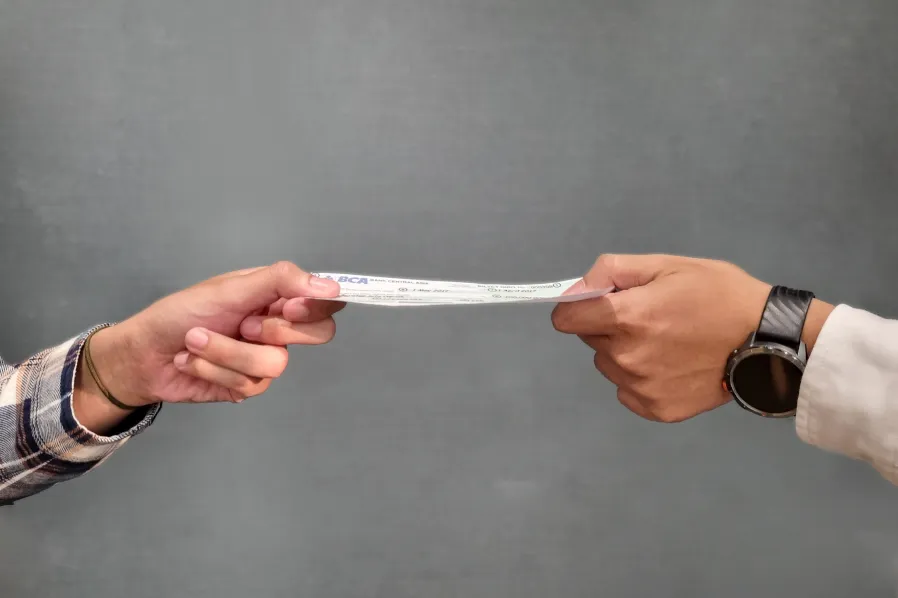
Business owners and entrepreneurs are usually familiar with the terms “Check” (cheque) and “Bilyet Giro” (BG). Both are transaction Cheque and/or Bilyet Giro used in banking.
Although both are useful for facilitating transactions, Cheque and Bilyet Giro actually have different characteristics.
Let’s take a closer look at Cheque and Bilyet Giro, from their definitions and benefits to their differences and important usage guidelines.
Definitions of Cheque and Bilyet Giro
A check is an unconditional order from a customer to the bank where their funds are held to pay a certain amount of money upon presentation of the check. Cheque can be used for cash payments and fund transfers.
Meanwhile, a Giro Slip (BG) is an order from a customer (the Drawer) to the bank to transfer a certain amount of funds to the recipient’s account, whose name is listed on the Giro Slip.
Benefits of Cheque and Bilyet Giro
These two transaction services can assist customers with their transaction needs, particularly in business activities. Here are some of the benefits:
- Simplifies Payments
Cheque can be used as a payment method that can be cashed immediately at a bank. Meanwhile, a Giro Slip is used as a means to securely transfer a certain amount of funds to the recipient’s account.
- Supports Business Transactions
Cheque and Bilyet Giro can be used to fulfill payment obligations to business partners in accordance with the type of transaction and applicable regulations.
- Assists with Transaction Administration
Both utilize written documents that support payment record-keeping and business administration.
Differences Between Cheque and Bilyet Giro
At first glance, checks and Bilyet Giro appear similar because they are both written documents used in banking transactions. However, they have several key differences, namely:
Characteristics of Cheque
- Can be used for cash payments or fund transfers
- Can be transferred to another party
- Payment is made when the check is presented in accordance with applicable regulations
- Issued in Indonesian Rupiah
Characteristics of a Giro Slip
- Used only for transferring funds to the recipient’s account
- Cannot be transferred to a third party
- The transfer is processed in accordance with applicable regulations and on the
Thus, the main difference lies in the method of payment and their usage. Cheque can be used for cash payments, while Bilyet Giro are only used to transfer funds to the recipient’s account. Both have their own specific terms and conditions that must be considered before use.
Essential Facts About Cheque and Bilyet Giro
In addition to understanding their functions and differences, there are several terms and conditions regarding the use of checks and Bilyet Giro that BCA customers must know to avoid transaction rejections and penalties.
Terms and Conditions for Dud Cheque and Bilyet Giro
-
Issuing Dud Cheque or Bilyet Giro May Result in Penalties
Customers are not permitted to issue dud checks or Bilyet Giro for any reason. Cheque and Bilyet Giro presented for payment or transfer will be rejected by BCA as dud Cheque and/or Bilyet Giro if the current account balance is insufficient. -
Issuing Dud Cheque or Bilyet Giro Is Prohibited
In accordance with the applicable criteria and regulations, customers may be subject to sanctions, including the closure of their current accounts and the listing of their identities in the National Blacklist (Daftar Hitam Nasional or DHN). -
Pay Attention to the Reporting Deadline
Customers must report the fulfillment of their obligations to settle dud checks and/or Bilyet Giro within 7 (seven) Business Days after the rejection date.
Calculation of Rejected Cheque and Bilyet Giro
The calculation of rejected checks and/or Bilyet Giro applies to transactions processed through clearing or by book transfer to the bank where the funds are held. The calculation follows these provisions:
- Documents Classified as Rejected Cheque/Bilyet Giro
Cheque and/or Bilyet Giro submitted to the bank and subsequently rejected due to an insufficient checking account balance or a closed account will be classified as rejected checks or Bilyet Giro. - The Same Cheque and/or Bilyet Giro Is Counted Only Once
If a single check or giro slip is presented repeatedly and continues to be rejected due to insufficient funds or a closed account, the Cheque and/or Bilyet Giro is still counted as a single instance of a rejected check or giro slip. - Different Cheque and/or Bilyet Giro Rejected on the Same Date Are Counted According to Their Number
If multiple checks and/or Bilyet Giro are rejected on the same date due to insufficient funds or a closed account, the number of rejected Cheque and/or Bilyet Giro is calculated based on the number of rejected Cheque and/or Bilyet Giro.
This means that the calculation depends not only on how many times the Cheque and/or Bilyet Giro were submitted, but also on the number of rejected Cheque and/or Bilyet Giro and the reason for rejection.
National Blacklist (DHN)
For checking account holders who frequently conduct transactions using checks and/or Bilyet Giro, it is important to avoid being placed on the National Blacklist (DHN).
The National Blacklist (DHN) is an official registry managed by Bank Indonesia that contains the identities of customers who have been subject to sanctions for issuing dud checks and/or Bilyet Giro.
- Criteria for Inclusion of Customer Identities in the DHN
Current Account holders may be subject to sanctions in the form of suspension of the right to use checks and/or Bilyet Giro, as well as inclusion of their identities in the DHN, if they meet any of the following criteria:- Issuing 3 (three) or more separate dud checks and/or Bilyet Giro, each with a face value of less than IDR500,000,000, at the same bank within a 6 (six)-month period; or
- Issuing 1 (one) dud check or giro slip with a face value of IDR500,000,000 or more.
- Duration of Customer Identification Listing in the DHN
A customer’s identity may also be listed in the DHN if it has previously been listed by another bank. This listing in the DHN is valid for 1 (one) year from the date of issuance.
If the customer again issues a dud check and/or giro slip while their identity is still listed in the DHN, that identity will be listed again for the next period. The listing period is valid for 1 (one) year from the date of issuance of the most recent DHN.
In addition, the customer’s Rupiah checking account will be closed if they again issue a dud check and/or giro slip during the DHN sanction period.
Tips to Ensure Cheque and Bilyet Giro Are Not Rejected
Now that you understand what the National Blacklist (DHN) is and what its criteria are, here are some tips to ensure your checks and/or Bilyet Giro are not rejected and to avoid penalties under the National Blacklist (DHN).
- Ensure You Have Sufficient Funds
Check your checking account balance before issuing a check and/or giro slip to ensure that sufficient funds are available to cover the payment or transfer. - Pay Attention to the Payment Date
Cheque are typically paid upon presentation, while Bilyet Giro are processed starting from their effective date. Therefore, ensure you have sufficient funds in your checking account when the payment or transfer is made. - Verify the Completeness and Accuracy of the Information on Cheque and/or Bilyet Giro
Ensure that important transaction details, such as the date, the amount in numerals and words, and the signature on checks and/or Bilyet Giro, are correct and comply with regulations. - Resolve the Issue Immediately If a Check or Giro Slip Is Rejected
If a check and/or giro slip is rejected due to insufficient funds, fulfill the payment obligation immediately and report the fulfillment to the bank within 7 (seven) Business Days after the rejection date.
Cheque and Bilyet Giro have different functions and regulations. By understanding both, business transactions can run smoothly, and the risk of penalties can be avoided.
To support the smooth flow of business transactions, BCA Giro is the right choice. For more information about BCA Giro, please visit the BCA Giro page!


